
- Role
- UX & interface design
- Tool
- Figma, Prototyping, 3D reference
- Tags
- product · digital · experiment
Overview
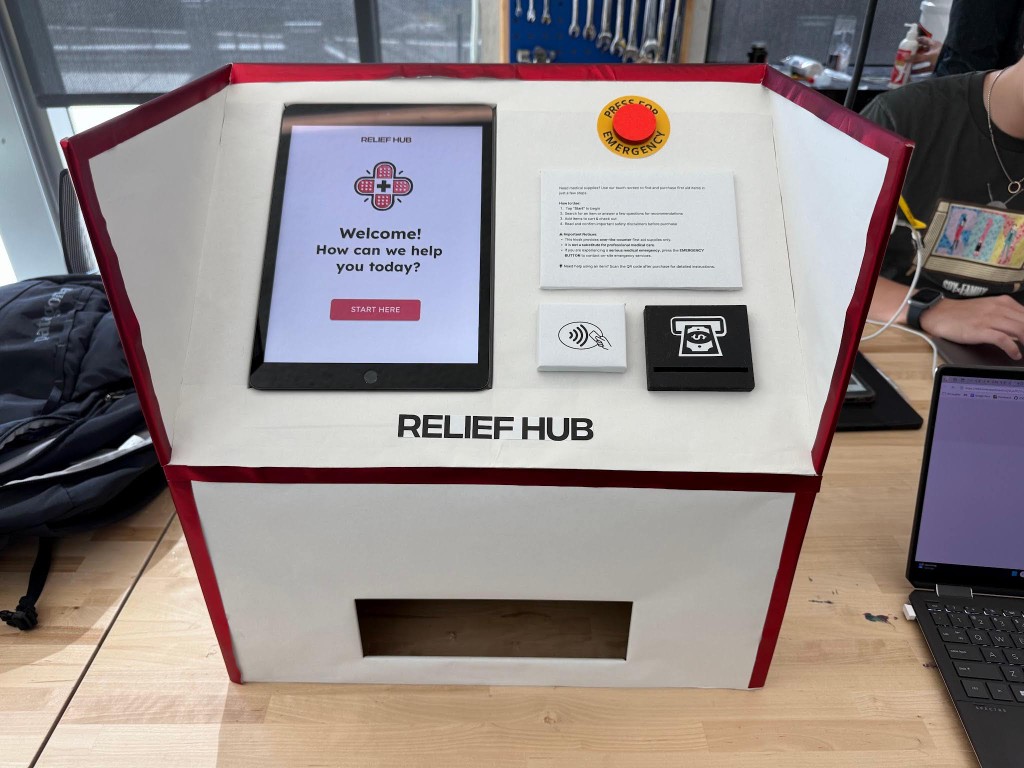
ReliefHub is a self-service first-aid kiosk concept for high-traffic venues (festivals, stadiums, concerts) where lines and noise make it hard to get quick help for minor issues. The system pairs a physical station—screen, emergency control, payment/NFC affordances, and a dispensing bay—with a mobile companion flow so guests can search, run a short symptom questionnaire, see recommendations, review medication warnings, and check out without a staffed desk.
Visual language follows a clinical retail palette: maroon wordmarks and headers, coral primary actions, off-white surfaces, and high-contrast type so hierarchy reads at arm’s length on the kiosk and in bright daylight on phone.
Artifacts below move hardware mockups and renders → early prototypes → wireframes → high-fidelity mobile and kiosk screen explorations (including alternate layouts and warning/checkout states).
- Defined dual entry: browse/search SKUs vs. guided questionnaire when the guest is unsure what they need
- Mapped flows through symptoms, pain/injury branching, search results, recommendations with quantity and cart actions, warnings (e.g. acetaminophen limits), and checkout affordances
- Designed always-available emergency signaling on the kiosk surface without competing with the main task UI
- Iterated 3D-style kiosk shells (studio white, outdoor night, dual-view renders) to align industrial form with UI chrome and red trim language
- Stress-tested readability and tap targets for one-handed mobile use in line and glanceable kiosk use at distance
- Packaged narrative in the ReliefHub overview PDF and A3 final presentation—both linked as downloadable PDFs in the artifact grid
Process & artifacts
Hardware explorations, Figma prototypes, wireframes, high-fidelity mobile + kiosk screens, the ReliefHub process PDF, and the A3 final deck PDF.